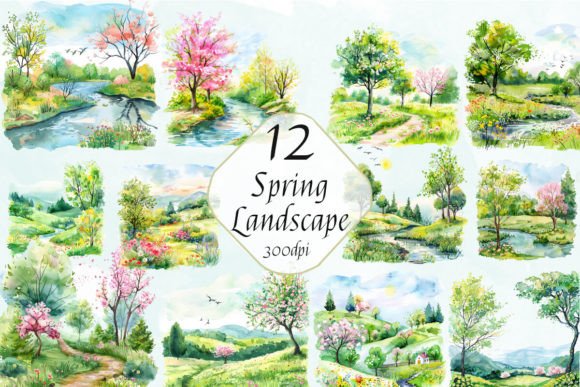
Understanding Watercolor Spring Landscape Clipart for Creative Projects
When embarking on a design project, the choice of visual assets can significantly influence the final aesthetic and emotional impact. Watercolor Spring Landscape Clipart has emerged as a popular resource for designers, hobbyists, and small business owners seeking to infuse their work with a sense of renewal, softness, and organic beauty. This article explores the characteristics of these digital illustrations, evaluates their practical applications, and provides guidance on determining whether they align with your specific creative goals.
Defining the Aesthetic and Technical Specifications
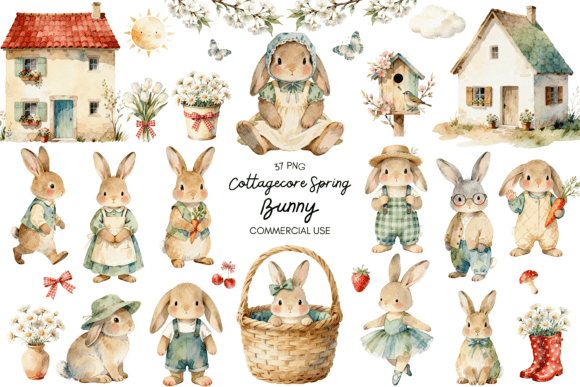
Watercolor art is characterized by its translucent layers, fluid edges, and gentle color gradients. When applied to landscape themes—such as blooming meadows, budding trees, or serene rivers—it evokes the tranquility and vibrancy of the spring season. Digital clipart in this style replicates these traditional media effects using high-resolution scanning or digital painting techniques.
For professional use, technical specifications are just as important as artistic style. High-quality Watercolor Spring Landscape Clipart typically comes in PNG format with transparent backgrounds. This transparency is crucial because it allows the image to be layered over various backgrounds without a visible white box around the edges. Standard professional files often feature dimensions of 4000 x 4000 pixels at 300 DPI (dots per inch). This resolution ensures that the images remain crisp and clear when printed on physical products, while also being large enough to be scaled down for web use without losing detail.
Evaluating Practical Applications
The versatility of spring-themed watercolor graphics makes them suitable for a wide array of projects. Understanding where these assets fit best can help you maximize their value.
Print-on-Demand and Physical Products
One of the strongest use cases for high-resolution clipart is in the creation of physical goods. The soft, hand-painted look appeals to consumers looking for artisanal or boutique-style items. Common applications include:
- Greeting Cards and Invitations: The delicate nature of watercolor complements events like weddings, baby showers, and Easter celebrations.
- Apparel and Accessories: Designs can be printed on t-shirts, tote bags, and mugs. The transparent background simplifies the process of placing the artwork on colored fabrics.
- Home Decor: Wall art, throw pillows, and stickers benefit from the calming visual properties of landscape scenes.
Digital Design and Web Content
Beyond physical printing, these assets are effective in digital spaces. Website headers, blog post featured images, and social media graphics can utilize spring landscapes to create a seasonal refresh. Because the files are easy to resize with standard software, they adapt well to different screen dimensions and layout requirements.
Benefits and Tradeoffs
Choosing pre-made clipart over custom illustration involves several tradeoffs. It is essential to weigh these factors against your project requirements.
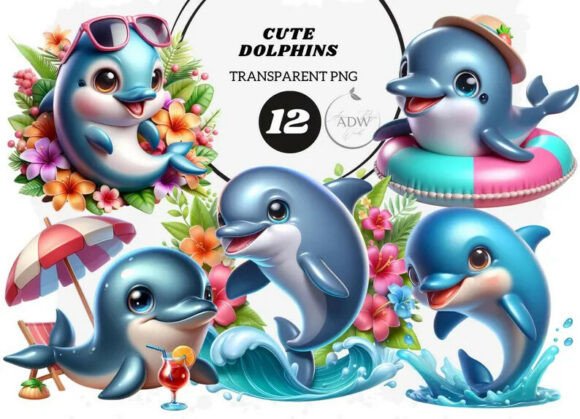
Cost and Time Efficiency: Commissioning a custom watercolor painting is time-consuming and expensive. Using a clipart pack offers an immediate solution. For example, a set containing 12 unique PNG files provides a variety of elements that can be mixed and matched, offering diversity without the need for multiple commissions.
Consistency vs. Uniqueness: A curated clipart set ensures visual consistency across a brand’s materials. However, because these are stock assets, there is a possibility that other designers may use similar images. If absolute uniqueness is critical for a major brand campaign, custom work may still be necessary. For small businesses, personal projects, or limited-run products, clipart offers a balanced compromise between quality and exclusivity.
Technical Ease: Working with transparent PNGs is straightforward for users with varying levels of design expertise. Unlike vector files, which require specific software to edit paths, raster PNGs can be dragged and dropped into most design platforms, including Canva, Adobe Photoshop, and Microsoft Word. This accessibility lowers the barrier to entry for non-designers.
Key Considerations for Selection
Not all clipart sets are created equal. When evaluating Watercolor Spring Landscape Clipart, consider the following criteria to ensure the product meets your needs:
- Resolution and DPI: Ensure the files are at least 300 DPI if you intend to print them. Lower resolutions may appear pixelated on paper, even if they look fine on a screen.
- Background Transparency: Verify that the images have true transparent backgrounds. Some lower-quality files may include a white background that requires manual removal, adding unnecessary work to your workflow.
- Cohesion of Style: Look for sets where the color palette and brushstroke styles are consistent. Mixing disparate watercolor styles can result in a disjointed final design. A well-curated set of 12 files should feel like part of a unified collection.
- Licensing Terms: Always review the license agreement. While many creators allow for commercial use on physical products, restrictions may apply to digital resale or mass production limits.
When to Choose Alternatives
While watercolor landscapes are versatile, they may not be the ideal choice for every project. If your brand identity relies on sharp, geometric lines, corporate minimalism, or high-contrast neon colors, the soft, organic nature of watercolor might clash with your messaging. In such cases, vector-based flat design or photographic imagery might be more appropriate.
Additionally, if you require specific landmarks or highly accurate botanical representations, stock clipart may lack the necessary precision. Watercolor is an interpretive medium, prioritizing mood and atmosphere over exact realism.
Making the Decision
To determine if Watercolor Spring Landscape Clipart is the right asset for your next project, ask yourself the following questions:
- Does my target audience respond well to handmade, organic aesthetics?
- Do I need high-resolution files capable of supporting both print and digital formats?
- Is my timeline tight, requiring immediate access to ready-to-use assets?
- Am I comfortable working with raster images (PNGs) rather than editable vectors?
If the answer to these questions is yes, investing in a high-quality clipart bundle can streamline your design process. The ability to easily resize and layer these images allows for rapid prototyping and production. Whether you are creating invitations, designing website elements, or producing merchandise, these digital tools provide a foundation for professional-looking results without the steep learning curve of traditional painting.
Ultimately, the value of these digital assets lies in their ability to bridge the gap between artistic expression and practical application. By selecting files with proper technical specifications—such as 4000 x 4000px dimensions and transparent backgrounds—you ensure flexibility and quality across all mediums. As you explore options, focus on finding a collection that resonates with your creative vision while meeting the technical demands of your intended output.